


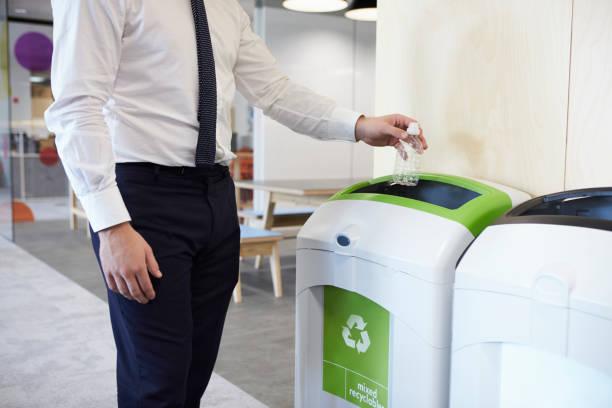
Most people pick an indoor bin based on how it looks. That’s not entirely wrong — aesthetics matter, especially in shared spaces — but it’s about fourth on the list of things that actually determine whether a bin does its job.
Let’s go from the top.
What the Bin Needs to Do First
An indoor recycling bin has one job: make sorting the default behaviour, not the deliberate one. If using it correctly requires someone to stop, think, and make a decision under time pressure, it will fail not because people don’t care, but because people are busy and habits win over intentions every time.
The product design needs to remove that decision wherever possible.
Indoor recycling bins that achieve this tend to share a few characteristics: multiple compartments that keep streams separated, clear labelling or aperture lids that limit what can go in each section, and placement close to where the waste is actually generated.
The bin that sits behind a door in a utility room will always underperform the bin sitting on the kitchen worktop or under the desk. This seems obvious. It still gets ignored constantly.
Compartment Design: One Bin vs Multiple
There are two main configurations for indoor recycling.
Single-stream bins with separate units: one bin per material type, placed side by side. This works well where floor space allows and where waste volumes per stream are high enough to justify individual units. Offices with heavy paper use often run a dedicated 50-litre paper bin beside the printer and a separate mixed recycling bin in the kitchen.
Multi-compartment combined units: two or three sections in one housing, usually sharing a footprint roughly equivalent to one large bin. Better for kitchens, smaller offices, and any space where you want separation without visual clutter. The trade-off is that each section has less capacity, so you need to empty more frequently or the system breaks down quickly during busy periods.
For most households, a dual-compartment kitchen bin general waste and recycling side by side is the single biggest practical upgrade available. Waste separation rates in homes that use them are measurably better than in homes running single-stream bins with a separate recycling bag on the floor.
Sizing: The Part Most People Under-Specify
A kitchen that generates about 15 litres of general waste per day needs a general waste compartment of at least 25 to 30 litres to avoid daily emptying. Add in 10 to 15 litres of recyclables and you’re looking at a combined capacity of 40 to 50 litres minimum for a family of four.
Smaller units — the 2×15-litre or 2×20-litre range suit couples or single-person households. They also work well as desk-side office units or bathroom bins where volume is naturally lower.
I’ve seen offices roll out 15-litre indoor recycling bins across a 100-person floor and then wonder why bins were constantly overflowing by Wednesday. The calculation wasn’t hard; it was just never done. Volume per person per day, times number of users, divided by collection frequency. Takes five minutes. Saves a lot of frustration.
Lid and Aperture Options
Open-top indoor recycling bins work for paper and card dry materials that don’t need odour control and benefit from easy access for awkward shapes like flattened cardboard.
For food waste caddies and any wet materials, a lid is not optional. An open food waste caddy indoors becomes an odour problem within 24 hours in a warm kitchen. Swing lids work; step-pedal lids are better where hygiene is a priority.
Aperture lids designed with a specific hole shape for bottles, cans, or paper are particularly useful in shared spaces like offices and co-working environments where you can’t rely on everyone knowing what goes where. The physical design does the sorting work that a label asks people to do voluntarily.
Materials and Longevity
For indoor use, polypropylene bins are the standard. They’re light, easy to clean, available in a range of finishes, and reasonably durable under normal use. The failure points are usually the lid mechanism and the inner bucket handles check that both are robust before buying, especially for high-traffic locations.
Stainless steel indoor recycling bins are worth the upgrade in kitchens and break rooms that take significant daily use. They handle cleaning better — including disinfectant wipes that degrade plastic finishes over time and they don’t retain odours after a thorough clean.
Bamboo-composite bins have become more common in the premium domestic market. They look good and they’re a reasonable choice for rooms where aesthetics matter more than volume. Durability under commercial conditions is lower than steel or quality PP.
Where to Put Them: The Real Deciding Factor
This is worth treating seriously. A mediocre bin in the right place beats a great bin in the wrong one.
Kitchens: at the workstation, not under the sink. When people are clearing plates and food prep, they need the recycling option right there, not a two-step process of opening a cupboard. Under-sink units work for households with strict space constraints, but they reliably produce more contamination than worktop-adjacent units.
Home offices: a small paper/mixed recycling unit beside the desk. Most home office waste is paper, cardboard packaging, and drink cans. A slim 20-litre unit handles this comfortably and keeps the recycling habit tied to the point of generation.
Shared office spaces: at every print station, in every kitchen and break area, and this is the one that gets overlooked at the entry and exit points where people carry in packaging from outside. If there’s no recycling option near the door, the coffee cup goes in general waste. Every time.
One More Practical Point
Liner bags. Worth mentioning because it’s a common friction point. Most inner caddy sizes don’t align with standard bin liner dimensions, which means people either use liners that bunch up or go without, which makes emptying unpleasant.
Buy bins that are compatible with standard bag sizes, or check that the manufacturer offers compatible liners before you commit to a size. It’s a small thing. It’s also the reason a lot of perfectly good bins get abandoned after a month.